
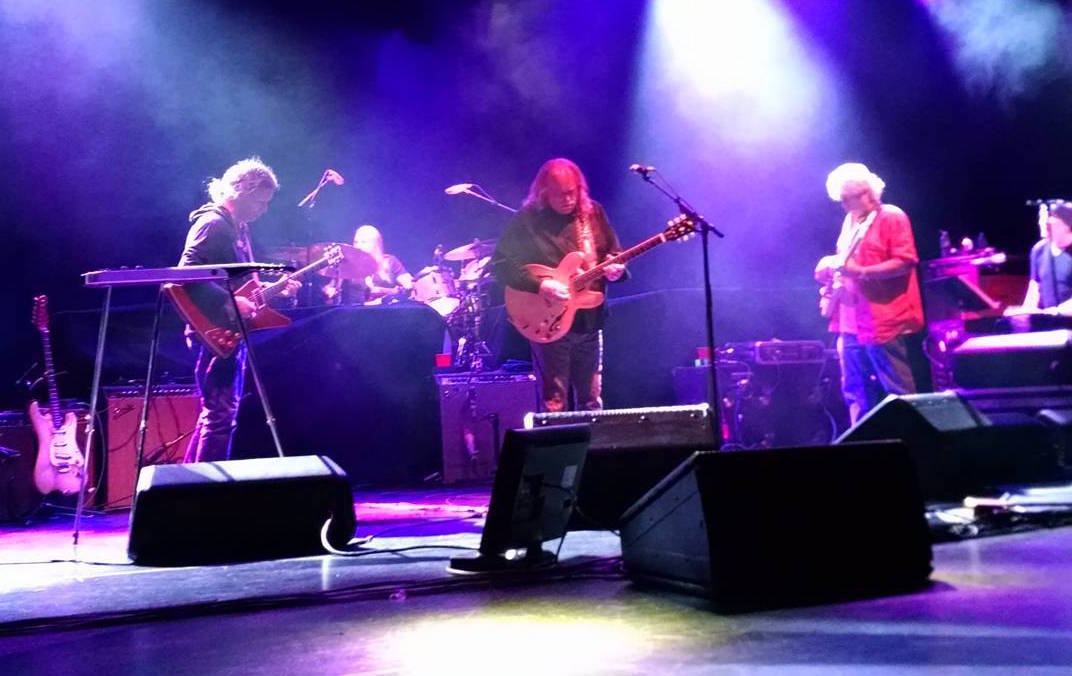
In one way, shape or form, Gov’t Mule virtually always surprise in concert, so it only stands to reason that the element of novelty would be elevated for their annual New Year’s run at the Beacon Theatre in NYC. And that holds true even if, as with the most recent two nights, the concept of the shows, as well as the roster of guests, were announced well in advance. In contrast to arguably ill-prepared and/or conceived theme evenings of recent years, the Mule shows of 12/30 and 12/31/2015, with guests aplenty, effectively explained why setlists and personnel lineups can only tell so much.
Given the fact that Gov’t Mule hadn’t played together since September at the Lock’n Festival, it only stood to reason the quartet concentrated on tried and true material for their opening set at the beautiful Broadway venue. Vintage tunes such as “Painted Silver Light” and “Dolphineus” dominated, with only a couple more recently recorded numbers appearing and those for their topical slant: it was hard not to think the frenetic “Mr. Man” didn’t refer to Trump while “Unring the Bell” hearkened to the violent social disarray of our times.
And if there were attendees among the devoted crowd hoping for pure Mule prior to the New Year’s Eve show, they were disappointed (albeit only slightly by the time it was over) when an obviously upbeat Warren Haynes announced it was time to “turn this into a party” just prior to welcoming guitarists Steve Kimock and Jack Pearson to the stage. Conan’s bandleader Jimmy Vivino also sat at the keyboards as the ensemble warmed up with the Grateful Dead’s “Sugaree” before former Allman Brothers Band pianist (and current Rolling Stones musical director) Chuck Leavell came out to sit at his own piano, while Vivino’s partner in the Beatles’ tribute, the Fab Faux, Will Lee, took over the bass from Jorgen Carlsson. As the expanded band eased its way into the Allman Brothers’ “Dreams,” offering a taste of what was to come the next night, Pearson’s fulsome guitar tone (with and without slide), combined with his affinity for the musicians around him, prompting one wag to comment, “Why haven’t we heard more from this guy?” Indeed, the predecessor to Derek Trucks’ joining the Dixie rock icons virtually stole the show this night and the next.
That is, he compared most favorably to a similar level of inspiration and empathy emanating from guitarist/vocalist Larry Campbell. Once of Bob Dylan’s band, a linchpin of Phil Lesh’s last great touring cadre of Friends and currently keeper of the studio in Levon Helm’s barn in Woodstock, Campbell cut an imposing figure with his longcoat and bearded countenance, but that only mirrored the authority with which he fired notes from his Telecaster and sang in a gruff voice calling to mind both Richard Manuel and Rick Danko, deceased members of The Band.
Beginning this middle set of three in surprisingly short order after an ingratiating near ninety minutes of opening Grateful Dead material, this quintet excelled at the most straightforward material they chose, such as the opening “The Shape I’m In,” “Don’t Do It” and the heady “Chest Fever.” “The Night They Drove Old Dixie Down” and “Up on Cripple Creek,” however, betrayed a bit of hurry. For his part alone, Haynes admires such material, but isn’t so deeply steeped in it as he is the canon into which he delved into early and (very) late in this close to five hour show.
Given his extended tenure in the Phil Lesh Quintet, as well as touring with The Dead in 2004, it only stands to reason the co-founder and titular leader of Gov’t Mule would bring such a relaxed air to the material of the Grateful Dead. And it was a wise choice indeed to open this marathon with this music, especially as, with the help of Kimock and Lincoln Schleifer on bass, Haynes and co. were able to connect with the capacity crowd from practically the first insinuating notes that led into now-classic Jerry Garcia/Robert Hunter songs such as “Tennessee Jed,” “China Cat Flower” and “Birdsong.” Sing-a-longs were almost continuous throughout the set, a marked contrast to the startled collective notion during the encore the night before. With former Vanilla Fudge (and Rod Stewart) drummer Carmen Appice sitting behind Matt Abts’ kit, while Vivino strapped on a guitar, Warren Haynes introduced the Jeff Beck/Tim Bogert/Appice arrangment of Stevie Wonder’s “Superstition,” the blazing, bone crushing likes of which marked another notable occurrence of rock history of 1973, along with the Summer Jam festival at Watkins Glen upon which the theme of New Year’s Eve was based.
Although the opportunity to play a set of Allman Brothers music made perfect sense for Warren Haynes, the presence of previous stalwarts Leavell and Pearson was in no way a given. While the former had sat in with the latter day Brothers more than once, the latter had become something of a forgotten man except within the community that grew up around the band through their final (sic) shows at this same venue in the autumn of 2014.
But with former Marshall Tucker Band drummer Paul Riddle displaying much finesse on one set of drums and SNL bandmember Shawn Pelton hammering on the other (and Matt Abts on percussion), the octet didn’t merely do justice to the legacy of the group Duane Allman founded, they informed the music with a depth of passion so personal, it might well stand as a point of closure for Haynes, and only slightly less so for Leavell, but to an even greater extent for Pearson.
All three men survived the fractious nature of the Allman Brothers Band’s interpersonal dynamic during their membership in its ranks, but during the course of two and half hours beginning at the stroke of midnight of 2016, they united with the five other musicians in a bond so simultaneously tight and abandoned, it was as if comparatively compact numbers such as “Wasted Words” held as much importance as extended improvisations such as that which closed the evening, appropriately enough, on “Mountain Jam.”
[youtube id=”WGOxsVxgWDE” width=”630″ height=”350″]
Following closely on the heels of an intense take on “Whipping Post,” itself proceeding in short order from the high-flying rendition of “Jessica,” where Leavell got his deserved spotlight, this twenty-minutes plus, even without bass or drum solos, was replete with the ingenuity and chemistry that earmarked the complementary nature of the relationship of late leader of the Allmans and his original partner, the now-estranged Dickey Betts (who never did show up this evening, contrary to both rumor and hope).
Remarkable as it was, neither the energy nor intensity ever flagged as the clock headed past 2AM from a 9PM start time, the actual duration of the performance paled next to the level of engagement of all involved, but personified by Warren Haynes: as depicted in the finely-tuned dynamics flowing through “In Memory of Elizabeth Reed,” free and unaffected by any lack of commitment from the players on stage around him, he made the most of his chance to honor the legacy of a band he played with longer (twenty-two years) than his two-decade plus tenure with Gov’t Mule.
In offering such respectful homage, Haynes also elevated the stature of the band as hosts to so unique an event, and yet, in doing so, achieved the more remarkable feat of preserving the emphasis on the music rather than the personalities involved (except in recognition of mutual respect). That’s no small accomplishment in itself, yet fully in keeping with the premise of the Beacon Theatre runs of Gov’t Mule and his own singular and altogether generous approach to musical collaboration.
Comments
Loading comments...
Leave a Comment